Is the conversation of play the world. Part 2: Play-worlds
Last month, I started addressing a question about where "the world" is in play. Is it in our imaginations and minds, or does it exist out there in the conversation and discourse?
After my first blog post on this question there was a brief chat on Bluesky that picked out the conversation side of the argument that helped me click with a bit more.
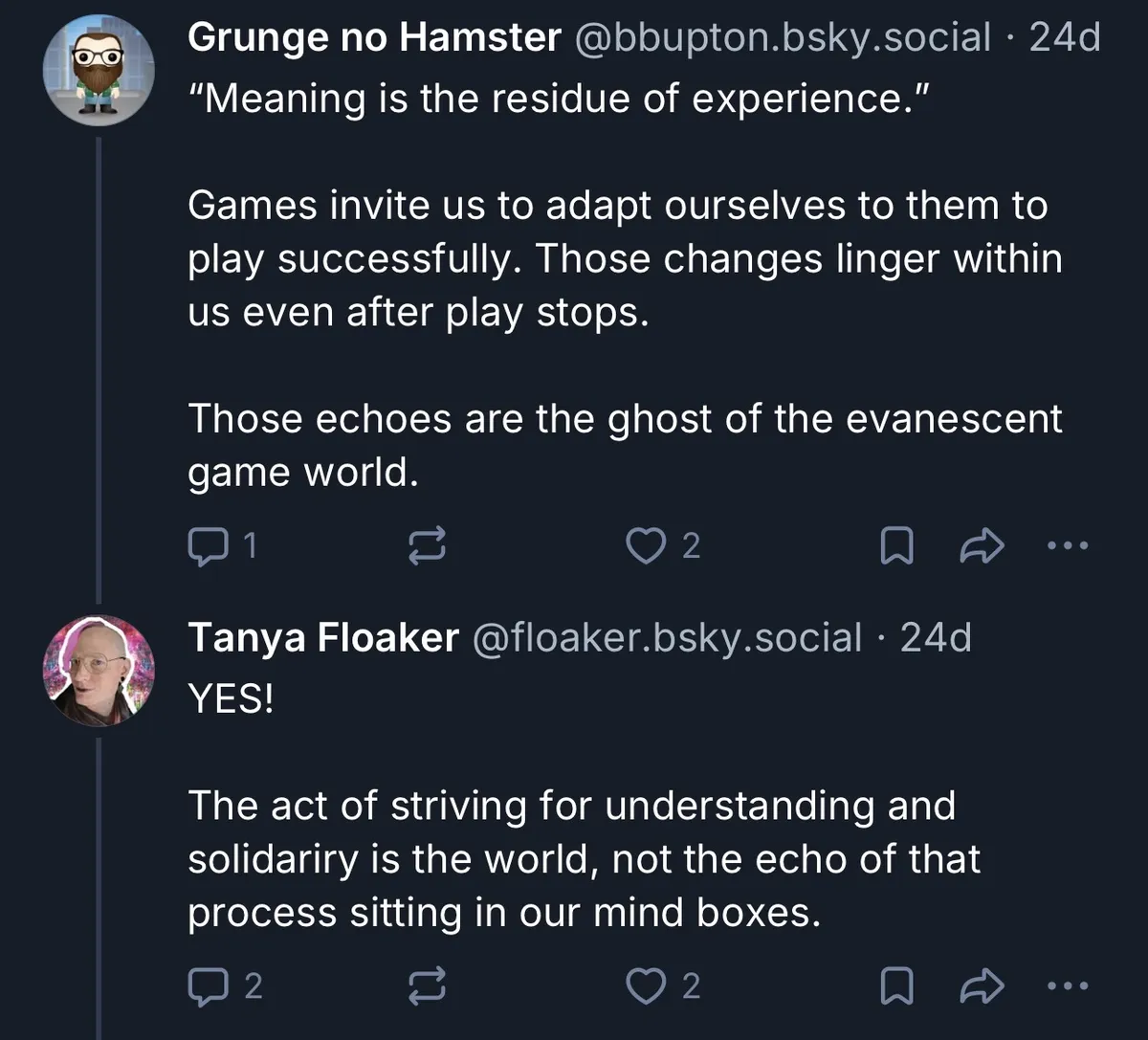
It is the idea of the 'striving' that resonated with me more than it had before. There is a nobility to the generation of that shared world and it is the shared-ness that makes it more concrete than our individual versions.
I thought then I would read around some academic things to see if I could find people who had discussed this idea in more detail. I came across a psychology paper by Kapitany, Hampejs and Goldstein (2022), called Pretensive Shared Reality: From Childhood Pretense to Adult Imaginative Play. I will refer to this paper as 'Kapitany et al.' (et al. meaning 'and others'). This paper, in part, addresses the question of "where" the world is during RPG play.
The World of Play
Kapitany et al. make the argument that things like TTRPGs make use of what they call a Pretensive Shared Reality (PSR). It is this thing that they say is the continuation of (and differentiation from) childhood pretend play.
The word 'Pretensive' in PSR refers to pretend, make-believe, imaginary.
By 'shared' they mean two things: the shared intentions to play, and the presence of some shared, 'institutional or normative... premises, assumptions, and semantic features that are durable for the period of group activity'. That is, it is shared because we play in our shared reality together, and it affects us together. It is a reality which we strive to engage in and with.
Is the Pretensive Shared Reality the "fictional world"?
In short, not exactly. The fictional world is entirely incorporated within the PSR but the PSR would also include things happening at the "table". The physical act of moving a miniature on a battle-map, would still be a part of the PSR because it would be part of our shared pretense that I am moving a creature in a space and not just a bit of plastic over a bit of paper.
What determines what is in the "play-world" of a PSR?
From this point I am going to stop saying PSR (you're welcome) and switch to play-world. This is partly because: this term is used in childhood play writings to describe this phenomenon; it matches that of the community that I am writing out of); and, as I will hopefully show, it describes a space that is "relevant to play" distinct from things that are not.
What Kapitany et al. suggest is the idea that play-worlds can be characterised on two axes of 'embodiment (externally, behaviorally relevant and observable behaviors) and cognition (complexity of the mental tasks).'
They talk about 'embodiment' as being about the degree to which the play-world requires a participant 'to perform actions which are externally visible and behaviorally representative of, and consistent with, the pretensive shared reality with their physical body'. These actions with the physical body include talking, writing etc.. So we could say that embodiment is to make use of conversation in a way that is consistent with the play-world.
For 'cognition' they say it is the degree 'to which the experience requires cognitive engagement that is consistent with the object of shared intentionality (i.e., the pretensive reality of the group).' In this model then, the mind (or imagination) is not separate from the shared element. It is shared too, it is the targeting of the mind at the shared play-world.
In simplifying this they draw on a standard observation of childhood that play can identified when actions are taken in relationship to that which is imagined, e.g.:
hiding under the covers of the bed, because a boogeyman is in the wardrobe.
So where is the play-world, in the conversation or the mind?
I'm going to do a diagram representing this article as I understand it (as a bit of an aside, I find trying to "draw" ideas one of the best ways to crystalise them for myself).
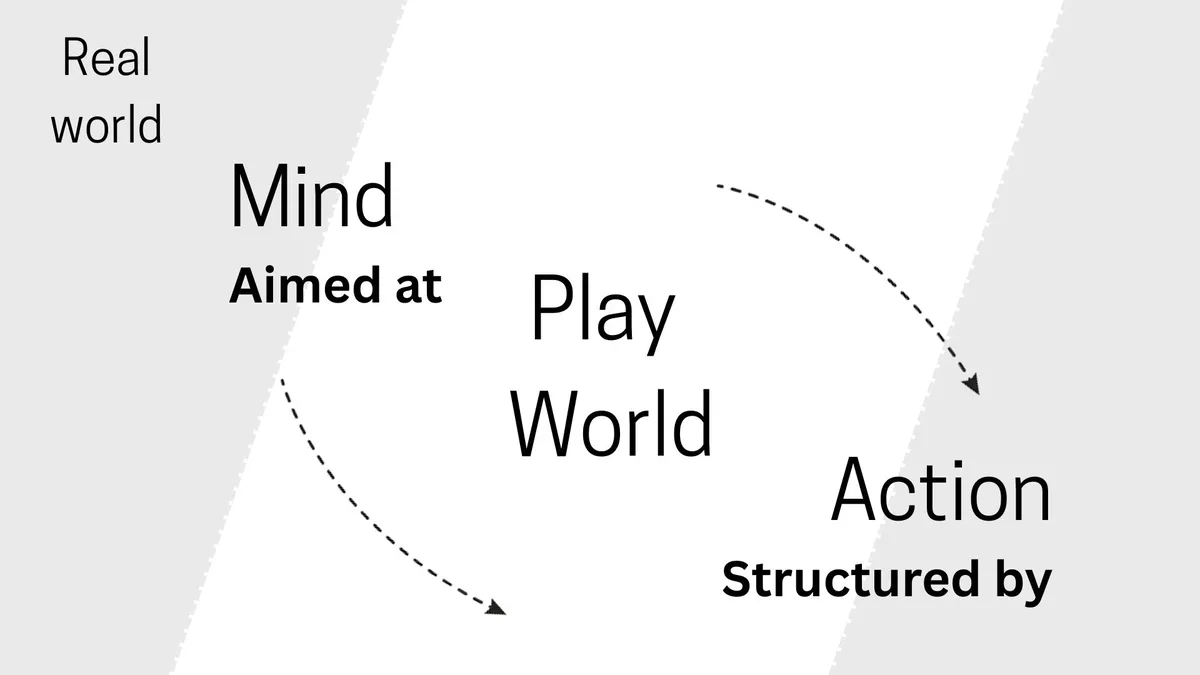
This is my image of how I have interpreted this. In the center is a porous bordered shape labelled play-world (Kapitany et al.'s pretensive shared reality). Outside of this shape is labelled Real World which perhaps we should more rightly think of as simply 'not-the playworld'. On one side, overlapping play and non-play-world is the phrase ‘Mind: Aimed at’ with an arrow running into the play-world and on the other, ‘Action: structured by’ with an arrow running out of the play-world.
Drawing this out, I think helps to answer the question. The (play-)world in this model is neither within the imagination/mind, nor is it within the actions/conversation. In fact, both of these things are "within" the play-world.
I feel we can think of it a bit like an event horizon for a black hole, or a solar system around a star. Both of these spaces are defined by the "direction of travel", wherein things are either trending towards the centre of mass - the star/black-hole, or they're not.
The play-world is a space defined by the shared intention of playing with it.
A short analysis of play
Let's take a brief excerpt from an actual play online, and see if we can see how thoughts/motivations/imagination lead to actions/conversation that together determine the nature of the play-world.
Mystery Quest, Mythic Bastion Land #1 46:44 - 47:15
A: [With anxious hand gestures] They could bottleneck us into a big net. Drive spears into our bodies and kebab us.
B: Calm yourself sir, it is fine.
C: What's the medieval equivalent of Valium
B: Lavender? Huff some lavender!
C: Something in one of my little leather satchels like a herb or -
GM: Yeah, there's probably like an opium, milk of the poppy.
A: What might soothe me is consulting my books again! How many times can I consult these books?
GM: You can do it again.
C: Getting your kippery fingers all over the pages.
Here we can see that the actions of A, are expressing the player's imaginings about/of his character (who is a worrier). B responds with their (character's) wishes of trying to calm the situation and expresses this in words. This is clearly shared by C whose words and actions raise up nearer to the "real world" to find a play-world equivalent for valium. A, though has kept their intentions on the idea of consulting his books, both as in-world consideration of what their character would do and a mechanical "do we agree this is part of the play-world right now". C, imagining the scene recalls an earlier detail from the breakfast their characters just ate.
I hope we can see clearly here patterns of thought/intention/imagination aimed at the play-world, and linked actions that respond to (and reinforce, change etc.) the play-world. In the way these things are forming, we can see the ever-shifting edges and even nature of that play-world.
Conclusion and implications for play
I think I am happy to have arrived at a conclusion to this question for myself. In answer to the question: 'Is the conversation of play the world', I would say: 'The conversation of play and the thoughts of play are a part of the world.'
As an individual player, this whole discussion becomes a question something like:
what is the play-world for me? What are its limits, its contents, who do I make it with?
In their writing Kapitany et al. call the play-world a 'workspace' of play. As players we are constantly constituting what this workspace includes and what it doesn't.
For me, the shared reality of the play-world is very strongly focused on the fictional world, the world that the characters are a part of. Once play (my thoughts and actions) tend too far away from that world, I stop feeling like I am playing in the way I want.
For instance, in the short example above, I am very happily saying 'What's the medieval equivalent of Valium?' but far less likely to say 'How many times can I consult these books?' For the simple reason that the first is a comment that draws on the non-play-world to help me explore the play-world, where the second is less tied to the logic of the fictional world and is more tied to the real world of the rulebook.
However, what doing this bit of writing has made me realise more is how for another person their play-world may happily be constituted by the more gamey-mechanical thoughts and I should perhaps accept that maybe I could see them as more of my play-world than I am inclined (maybe).
Coming Up
Another time I am going to pick up a thread that underlies this discussion from Nguyen (2020) which is the discussion of the medium of games, including TTRPGs, being agency. That is how we can think of the play-world, where do I enjoy playing with my agency and where don't I?
However, before that, I am going to start writing about a next-step for The Wyrd Lands, which is beginning to play with a System Reference Document (SRD) when you don't really have a traditional system.
Please follow along with this blog for more of my RPG musings and my accounts of designing The Wyrd Lands RPG and others.
Contact me on Itch
Email: wyrdrpgs@gmail.com
Instagram: thewyrdlands